In today's rapidly changing world, creativity has become one of the most valuable qualities young people can possess. Success in academics, the arts, technology, and even everyday life increasingly depends on the ability to think innovatively, adapt to new situations, and discover fresh solutions to challenges. For students and young minds, creativity is not merely a talent reserved for a few; it is a natural human capacity that can be cultivated and strengthened.
However, modern lifestyles often expose young people to increasing levels of stress, information overload, and academic pressure. These factors can inhibit the mind's natural ability to think clearly and creatively. As educators and parents seek ways to support the healthy development of young minds, growing attention has been directed toward the role of meditation in fostering creativity and cognitive development.
Among the approaches studied extensively by researchers, Transcendental Meditation (TM), as taught by Maharishi Mahesh Yogi, has shown promising results in supporting creativity, brain development, and overall well-being.
Why Creativity Matters for Young Minds
Creativity extends far beyond artistic expression. It is the ability to think flexibly, generate original ideas, and approach situations from multiple perspectives. Creative thinking enables students to solve problems more effectively, communicate better, and adapt to the demands of an increasingly complex world.
Young minds are naturally curious and imaginative. Yet stress, anxiety, and mental fatigue can restrict this natural flow of ideas. When the mind is overloaded, it becomes more difficult to concentrate, make connections, and respond with originality.
Providing the mind with opportunities for deep rest and rejuvenation can therefore play a vital role in nurturing creativity. This is one reason researchers have become increasingly interested in understanding how Transcendental Meditation improves creativity in young minds.
How Transcendental Meditation Supports Creative Thinking

Transcendental Meditation is a simple and effortless technique that allows the mind to settle naturally to quieter levels of awareness. During the practice, the body gains profound rest while the mind remains awake and alert. This state of restful alertness helps dissolve accumulated stress and fatigue, enabling the brain to function more efficiently.
As stress is reduced, qualities such as creativity, intelligence, and clarity begin to express themselves more naturally. Rather than forcing creative thinking through concentration or effort, TM creates favorable conditions for the mind to function with greater ease and coherence.
Many students and young adults report improvements in concentration, learning ability, and confidence after adopting regular meditation practice. These changes help create an environment in which creativity can flourish naturally.
The Role of Meditation in Brain Development
Modern neuroscience recognizes that healthy brain functioning depends on effective communication among different regions of the brain. Greater integration within the brain supports learning, emotional balance, and the ability to generate new ideas.
Scientific research has suggested that individuals practicing the Transcendental Meditation technique demonstrate greater whole-brain functioning in response to external stimuli. This more integrated style of brain activity is associated with improved cognitive performance and enhanced creative abilities.
These findings highlight the important role of meditation in brain development. By promoting more harmonious brain functioning, meditation provides a strong foundation for intellectual growth and helps young people develop their natural capacities more fully.
As the brain becomes more integrated, students may find it easier to process information, retain knowledge, and respond creatively to new situations. Such development is especially important during the formative years, when the brain is highly adaptable and responsive to positive influences.
How Meditation Improves Creativity in Students
Academic life often places considerable demands on students. Deadlines, examinations, and constant exposure to information can lead to stress and mental fatigue. These pressures can interfere with creative thinking and reduce cognitive flexibility.
Understanding how meditation improves creativity in students begins with recognizing the importance of mental rest. Just as the body requires sleep to function effectively, the mind also benefits from periods of deep relaxation.
Transcendental Meditation provides a unique state of restful alertness that helps rejuvenate the nervous system. When the mind becomes refreshed, it gains greater clarity and flexibility. Students are often able to approach challenges with renewed enthusiasm and discover solutions that may not have been apparent previously.
Creativity thrives in a mind that is calm, balanced, and energetic. By reducing stress and promoting mental clarity, meditation allows students to make fuller use of their intellectual and creative abilities.
Scientific Evidence Supporting Creativity
Research has provided valuable insights into the relationship between Transcendental Meditation and creative thinking.
A study published in Human Physiology found that practitioners of the Transcendental Meditation technique displayed greater participation of the brain as a whole when responding to stimuli. Such integrated brain functioning is considered beneficial for higher cognitive processes and creative performance.
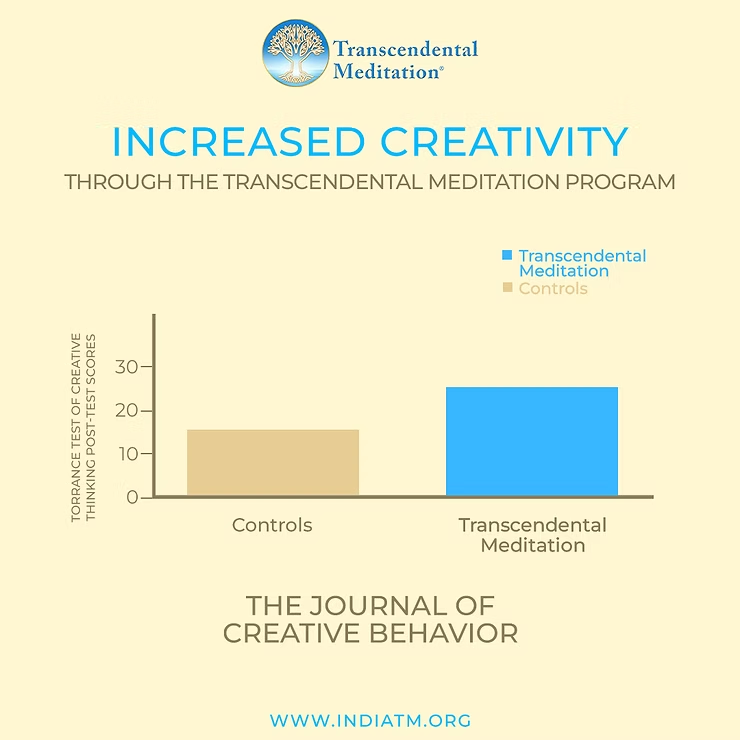
Additional evidence comes from a longitudinal study involving undergraduate students at Cornell University. Researchers observed that students who learned the Transcendental Meditation technique demonstrated greater improvements in originality and flexibility of thinking over several months compared with those who did not practice the technique. Measures of creative ability showed particularly encouraging gains in areas associated with generating novel ideas and adapting to new situations.
These findings offer valuable scientific support for understanding how Transcendental Meditation improves creativity in young minds and suggest that creativity can be enhanced through the systematic development of consciousness.
Transcendental Meditation Benefits Beyond Creativity
Among the many documented Transcendental Meditation benefits, enhanced creativity represents only one aspect of a much broader picture. Research over several decades has associated the practice with reduced stress, improved concentration, emotional well-being, and greater resilience.
For young people, these benefits can contribute significantly to academic performance and personal growth. A calm and balanced mind is better equipped to learn, build healthy relationships, and respond constructively to life's challenges.
Furthermore, greater emotional stability and self-confidence often enable students to express their talents more freely. When anxiety and mental fatigue are reduced, the mind naturally becomes more open, curious, and creative.
Nurturing the Innovators of Tomorrow
Young people represent the future of society, and their ability to think creatively will play an important role in shaping the world ahead. Encouraging habits that support mental clarity and healthy brain development is therefore an investment in the leaders, innovators, and problem-solvers of tomorrow.
Understanding how meditation improves creativity in students and appreciating the role of meditation in brain development can help parents, educators, and institutions provide young people with valuable tools for success.
As scientific research continues to explore the relationship between consciousness and human development, Transcendental Meditation offers a practical and effortless approach to nurturing the innate creativity present within every individual.
By providing deep rest to the mind and body and supporting more integrated brain functioning, Transcendental Meditation helps create the conditions in which intelligence, creativity, and happiness can naturally flourish. In doing so, it empowers young minds to realize their fullest potential and contribute positively to the world around them.